


Nobody plans for this conversation.
You did not grow up imagining the day you would sit across from your parent and try to figure out what comes next. But here you are — noticing things you did not notice a year ago. A fridge that is not as full as it used to be. A parent who sounds more tired than they should. A fall that scared both of you more than either of you admitted.
The question of whether to keep your parent at home or move them to a care facility is one of the hardest decisions a family can make. There is no perfect answer. But there is a right process — and it starts with understanding what each choice actually looks like, not just what it sounds like in a brochure.
This guide is for Bay Area families working through exactly this decision. We will cover the real differences between aging at home and assisted living, what each option costs in this market, and how to know which one fits your parent’s situation and your family’s reality.
Before we compare the options, it is worth naming what most families are actually hoping for when they start this search.
They want their parent to stay home.
Not because home is always the easiest answer, but because home is where their parent’s life is. Their routines. Their neighborhood. The chair they have sat in for thirty years. The kitchen where they know where everything is without looking. The independence that tells them, every single day, that they are still themselves.
Research consistently shows that most seniors want to age in place. And the families who love them, when they are honest about it, want the same thing — as long as it is safe, sustainable, and supported.
The question is not really “home or facility.” The question is: what does staying home actually require, and is that possible for my parent?
Aging at home preserves independence, familiar surroundings, and daily routine — all of which have real impacts on mental and physical health for seniors. Studies show that seniors who age in place report higher levels of life satisfaction and lower rates of cognitive decline than those who transition to care facilities. The one-on-one nature of in-home care also means your parent gets personalized attention rather than shared staff across multiple residents.Nobody plans for this conversation.
You did not grow up imagining the day you would sit across from your parent and try to figure out what comes next. But here you are — noticing things you did not notice a year ago. A fridge that is not as full as it used to be. A parent who sounds more tired than they should. A fall that scared both of you more than either of you admitted.
The question of whether to keep your parent at home or move them to a care facility is one of the hardest decisions a family can make. There is no perfect answer. But there is a right process — and it starts with understanding what each choice actually looks like, not just what it sounds like in a brochure.
This guide is for Bay Area families working through exactly this decision. We will cover the real differences between aging at home and assisted living, what each option costs in this market, and how to know which one fits your parent’s situation and your family’s reality.
Aging at home does not mean aging alone. For most families who make this choice, it means bringing in professional support so the home remains safe, manageable, and connected.
In-home care can look like a few hours of companionship several days a week. It can look like a caregiver who comes every morning to help with bathing, dressing, and breakfast. It can look like a live-in caregiver who is present around the clock. The care adjusts as your parent’s needs change — without the disruption of moving them to a new environment.
The caregiver is matched to your parent. Not assigned randomly. At Supreme Companions, families have the opportunity to meet their caregiver before care begins — because the relationship between a caregiver and the person they care for is as important as the care itself.
What does not change when a parent ages at home: their address, their neighbors, their routines, their sense of who they are. What does change is that they are no longer doing it alone.
For many seniors, aging at home with professional in-home care support is the better option — it preserves independence, familiar environment, and personalized one-on-one attention. Assisted living may be the right choice when a senior’s medical needs exceed what in-home care can provide, when significant memory impairment creates safety risks that require 24-hour supervised facility care, or when social isolation at home has become a concern. The right answer depends on the specific person, their health status, and their family’s situation.
Assisted living communities offer something that in-home care cannot: a structured environment with on-site staff, built-in social programming, and immediate support available at any hour. For seniors who need more oversight than an occasional caregiver visit can provide, or for those who benefit significantly from structured social activity, assisted living is a legitimate and valuable option.
But it is worth being honest about what the transition actually involves.
Your parent leaves their home. Their bedroom, their kitchen, their backyard, their routines — all of it changes at once. They move into a space they did not choose, with staff they did not pick, surrounded by people they do not know. For some seniors, especially those who are social and adaptable, this transition works well. For others, particularly those with strong connections to their home and neighborhood, it is genuinely hard.
The adjustment period is real. And it is worth thinking through before the move, not after.
The primary disadvantages of assisted living are the loss of independence and familiar surroundings, the shared-staff model that limits one-on-one attention, the high monthly cost, and the emotional difficulty of the transition for many seniors. Residents in assisted living facilities share staff with many other residents, which means care is less personalized than in-home care. Assisted living in high-cost markets like the San Francisco Bay Area averages $5,000 to $8,000 or more per month, significantly higher than comparable in-home care hours.
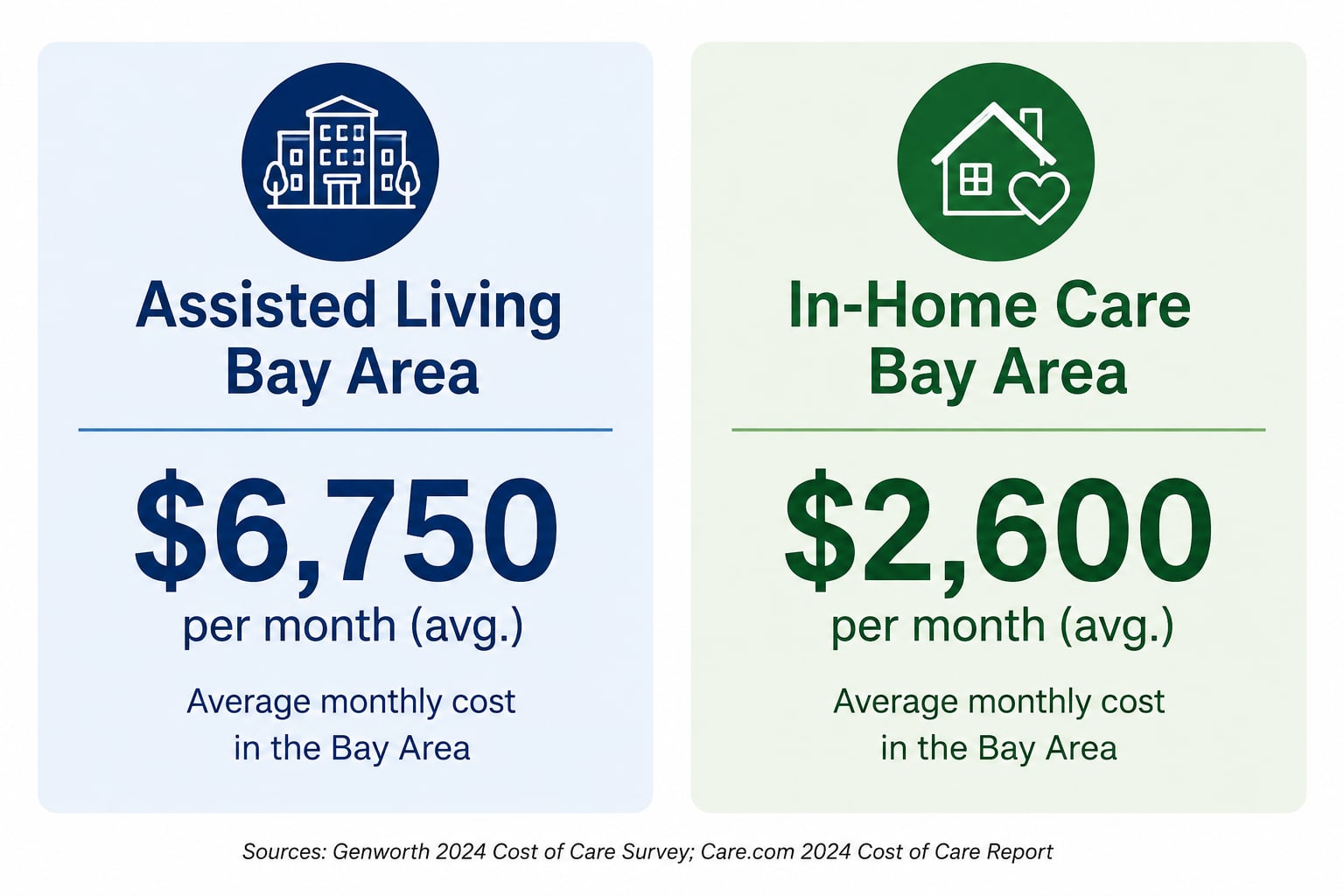
Cost is rarely the only factor, but it is almost always part of the conversation. Here is what Bay Area families are actually looking at.
Assisted living in the San Francisco Bay Area averages between $5,500 and $8,500 per month depending on level of care and facility. Memory care units, which serve seniors with Alzheimer’s or dementia, typically run $6,500 to $10,000 or more monthly. These figures do not include personal care add-ons, medications, or activities that some facilities charge separately.
In-home care costs vary based on the number of hours needed and the type of care provided. For families who need 30 to 40 hours of in-home support per week, the monthly cost is typically significantly lower than assisted living — while providing one-on-one care in the senior’s own home. Supreme Companions offers flexible hourly rates and accepts all long-term care insurance plans.
For families considering both options, the comparison is not just dollars. It is what those dollars provide. Assisted living pays for a facility and shared staff. In-home care pays for a dedicated caregiver whose entire attention, during their hours, is on your parent.
In the San Francisco Bay Area, assisted living typically costs between $5,500 and $8,500 per month. In-home care costs depend on the number of hours needed — families who require 30 to 40 hours of weekly support often find in-home care comparable or more affordable than assisted living, while receiving more personalized one-on-one attention. Many families also offset in-home care costs through long-term care insurance, which most licensed agencies including Supreme Companions accept.
Nursing homes are licensed medical facilities that provide 24-hour skilled nursing care for seniors with significant medical needs. In-home care refers to non-medical support — companionship, personal care, daily living assistance — provided by a trained caregiver in the senior’s own home. Most seniors do not require nursing home-level medical care. For those who need daily living support, personal care, or companionship, in-home care provides professional support while preserving independence and familiar surroundings.
Every family’s situation is different. But these are the signs that in-home care is likely the right fit — at least for now.
Assisted living may be the better choice when a parent’s medical needs exceed what in-home care can safely support, when significant memory impairment creates consistent safety risks at home, or when the senior genuinely would benefit from the structured social environment of a community setting.
Assisted living typically becomes necessary when a senior’s care needs exceed what in-home support can safely provide — usually when there are significant medical needs requiring licensed nursing oversight, advanced dementia with consistent safety risks such as wandering or falls, or when the senior requires 24-hour supervision that family members cannot provide and in-home live-in care has not been explored. Many families discover that in-home care, including live-in options, can meet needs they assumed required a facility.

We have been doing this for over 15 years in the Bay Area. We have worked with families navigating every variation of this decision. And the families who chose in-home care and stayed the course consistently tell us the same things.
“We used several home care agencies over a period of almost nine years. For the last three we used Supreme Companions and they were very dependable — definitely the best of all we used. Their caregivers were professional and compassionate. I always felt comfortable with their staff.” — Richard H., Bay Area Family
“Their workers are very professional and friendly. They are very reliable and truly take care of their patients.” — Den W., Bay Area Family
What these families have in common: they did not make this decision lightly. They researched. They worried. And they made the choice that let their parent stay home — surrounded by everything familiar — for as long as possible.
If you are reading this and the decision still feels heavy, that is normal. It should feel weighty — because it matters. But it does not have to be complicated.
Here is where to start.
The goal is not perfection. The goal is a plan your parent feels good about and your family can sustain.
At Supreme Companions, we have spent 15 years helping Bay Area families navigate exactly this decision. We are a family-owned agency — Crystal and Marlon Galang built this company because we believed every senior deserves compassionate, professional care at a price their family can actually manage.
We are licensed, bonded, and insured. Our 300+ caregivers are DOJ background-checked and Relias trained. And we will never sign you into a contract, because we believe the right care speaks for itself.
If you are working through this decision right now, we would love to talk. Our free in-home assessment is no cost, no obligation, and no pressure. Just an honest conversation about your parent’s situation and what the right support looks like for your family.
“The quality of our service is a reflection of our caregivers.”






Serving Bay Area families with compassion, dignity, and affordable in-home care since 2012.